
How Long Does an AI Implementation Take for a Mid-Market Company?

The honest answer is a range, and you control most of it. For a first workflow, plan on about two months for the pilot, then an ongoing roadmap. Two things set the length: how much you try to do at once, and how reachable your data is. One workflow with accessible data is a matter of weeks. A whole function with records scattered across six tools is a matter of quarters.
Here is how we plan it at ShooflyAI, phase by phase, with what slows each one and what speeds it up. These are planning ranges from how we scope work. They are not promises, and your calendar will differ.
The four phases at a glance
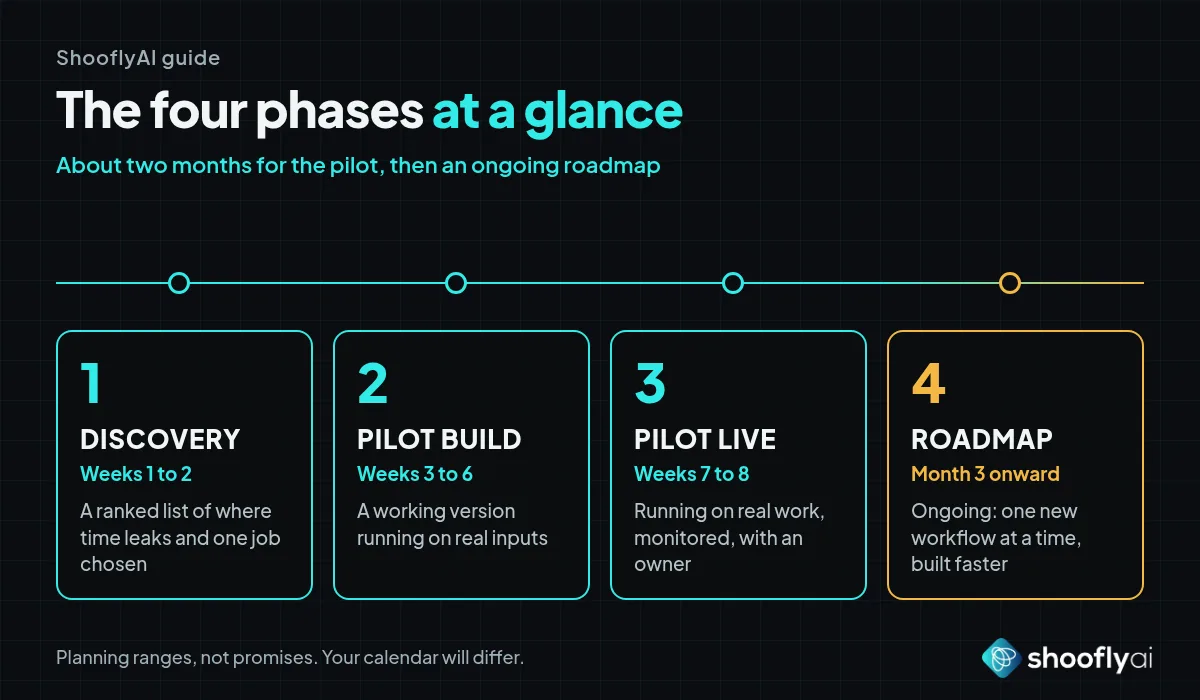
The pilot is the first two months, counted from kickoff. The roadmap is everything after it.
Phase 1: Discovery (weeks 1 to 2)
This is the Blueprint, and it costs $6,000. We sit with the people who do the work, not just the people who manage it. Managers describe the process on the slide. The person doing it describes the process that actually exists, with the spreadsheet on the side and the one customer who always gets handled differently.
You leave with a ranked list of jobs, a readiness read on the data behind each, and a recommendation for what to build first. Our AI implementation roadmap shows the sequence.
What slows it: nobody free to explain how the work really runs. Two hours with the person who does the job beats ten hours of workshops.
What speeds it: a short list. If you walk in already knowing the three jobs that hurt, discovery is about confirming and ranking, not finding.
Phase 2: Pilot build (weeks 3 to 6)
We write down the single number that will prove this works, measure where it sits today, and build against it. Skip the baseline and you will argue about results for a month.
The build is the part people expect to take longest. It often does not. The calendar gets eaten by access: a login to the accounting system, a permission in the CRM, a security review that sits in someone’s queue. Ask for access on day one.
What slows it: scope that grows. A request to “also handle” a second case in week four adds weeks, because every case has its own exceptions.
What speeds it: one source of truth for the data the job needs, cleaned before the build starts, and one person who answers questions the same day.
Phase 3: Pilot live (weeks 7 to 8)
The pilot runs on real work with a human checking every output. That is deliberate. You need enough real runs to see where it is wrong, and the pattern only shows up on live work, not test data. Then we tighten: monitoring, the edge cases the pilot found, documentation, and training for whoever will run it.
This is also where you name the owner. A system with no owner decays the first time a source changes. The options are laid out in who maintains custom AI.
What slows it: a reviewer who is too busy to review. The pilot then drags, and nobody trusts it enough to switch off the manual step.
What speeds it: deciding up front what “good enough” means, in numbers, so the sign-off is a check against a line and not a debate.
Phase 4: The ongoing roadmap (month 3 onward)
After the pilot, the work does not end. It becomes a roadmap. The second workflow reuses the access, the data cleanup and the review habits from the first. Teams that have shipped one are quicker on the next because they know what to hand over and how to judge the result.
The roadmap is also where programs go wrong. The temptation is to launch the next five at once. Why most AI projects stall describes how that ends, and why AI pilots fail covers the earlier trap of a pilot with no baseline. Add one workflow at a time until the cadence is boring.
Why the same project takes twice as long somewhere else
In our experience the technology is rarely the reason. The delays are organizational. A company where one executive can say yes moves in the range above. A company where three departments must agree on access to one dataset spends the first month on that conversation. Neither is wrong, but you should know which one you are before you pick a date.
Data readiness is the second driver. If the records the job needs are complete and in one place, build time is short. If half the history lives in someone’s inbox, cleaning comes first and can double a phase. Discovery exists to surface this before you have paid for a build. For the money side of the same question, see how much custom AI costs.
How to shorten your own timeline
Pick one job, not three. Get the data for it into reach before kickoff. Name the person who approves the result and make sure they have the authority to say yes. Request system access the day you sign. Those four moves remove most of the delay we run into.
Then hold your partner to a phase table with your names and dates in it. A partner who cannot fill one in has not scoped the work yet.
Frequently asked questions
How long does an AI implementation take for a mid-market company?
Plan on about two months for the pilot: one well-scoped workflow, from kickoff to live use with a person checking the output. After the pilot comes an ongoing roadmap, where each further workflow is added in turn and tends to go faster than the last. A company-wide program is several of these in sequence.
What is the fastest an AI implementation can realistically go?
Two months is the realistic pilot when the job is narrow, the data is reachable and one person can approve the result. You can go faster by cutting scope. You cannot go faster by skipping discovery, because that is where the wrong job gets caught.
What makes an AI implementation run late?
Four things, in the order we see them: scope that grows mid-build, data spread across tools nobody has mapped, system access that takes weeks to approve, and no single person with authority to say the result is good enough. All four are visible before kickoff.
What does the Blueprint cost and what does it cover?
The Blueprint is $6,000. It is the discovery phase: we map how the work actually runs, rank where time and money leak, and hand you a sequenced plan for what to build first. You can take it to us or to anyone else to build.
What happens after the two-month pilot?
The pilot becomes the first line of an ongoing roadmap. Source systems change, edge cases appear, and someone has to own upkeep, so the work does not stop at go-live. The roadmap sequences the next workflows, and each reuses the access, data cleanup and review habits from the pilot.
Should I run several AI projects at once?
Usually not. One workflow gives you a baseline, a result you can measure and a team that has done it once. Five at once tends to stall all five, which is the pattern behind most stalled programs.