
AI Implementation Partner vs. Consultant vs. Agency vs. Managed AI Services
Four categories of firm will answer an RFP for AI help. They use overlapping language and sell different things. The consultant sells advice. The agency sells a build. The managed services firm sells operations. The implementation partner sells all three under one KPI. This post lays them side by side so you can see which gap each one fills.
We wrote an earlier take on two of these categories in AI consultant vs. AI agency. This post widens the frame to four categories. It adds the two lines that matter most: who owns the code, and who is accountable after launch.
Sells advice
Assessment, strategy and a roadmap. No working software.
Sells a build
Design, build and deploy of a specific system. Often ends at handoff.
Sells all three under one KPI
Diagnostic, build and operations of one business function under one agreement.
Sells operations
Operation, governance and improvement of AI already in production.
The four categories in one table
| AI consultant | AI automation agency | AI implementation partner | Managed AI services | |
|---|---|---|---|---|
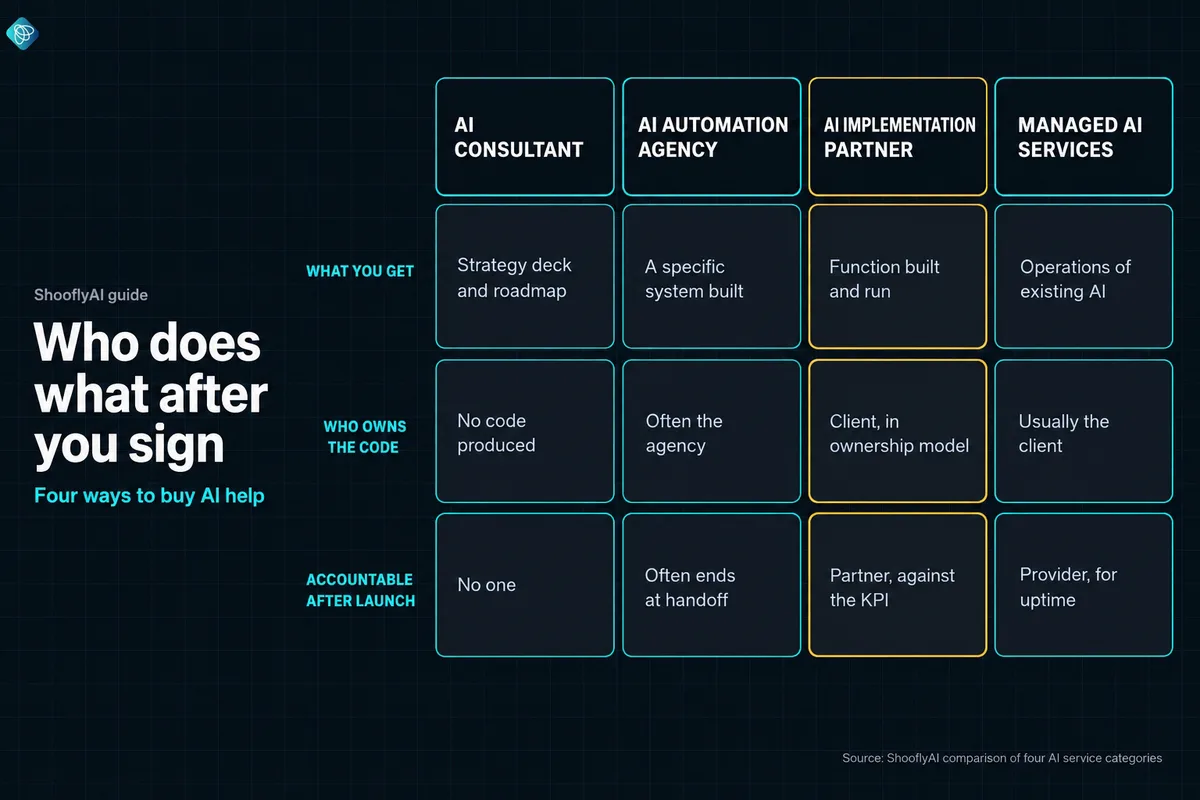
| What you get | Assessment, strategy and advice. A deck and a roadmap, no working software. | Design, build and deploy of a specific system. Some manage it after. | A scoped function built, launched, run and extended. Diagnostic, build and operations under one agreement. | Operation, governance and improvement of AI already in production. |
| Who owns the code | No code is produced. | Varies. Often the agency or its platform, with the client renting access. | Varies by firm. In the ownership model the client holds the code, data and infrastructure. | Usually the client. The provider operates what exists. |
| Who is accountable after launch | No one. The engagement ends at the deck. | Often no one. Handoff ends most agency engagements. | The partner, against the function’s KPI, for the life of the retainer. | The provider, for uptime and governance of the existing system. |
| Typical buyer | Enterprise leadership planning a program. | Small businesses that need one build. | Mid-market operators, often $10M to $75M companies, with a function to run. | Companies with production AI and no team to run it. |
| Typical price shape | Project fee or day rate for the strategy engagement. | Fixed-price build, sometimes plus a platform subscription. | Paid diagnostic, then a monthly retainer per function. | Monthly fee for operating existing systems. |
The definitions in the table draw on two industry sources. Master of Code describes an implementation partner as the firm responsible for getting AI to work inside your business and staying accountable after launch (source). Twelverays describes managed AI services as the work of operating, governing and improving production AI (source).
What does an AI consultant give you?
A consultant assesses your business, identifies use cases, and hands you a strategy. The good ones save you from building the wrong thing. That value is real, and it is the whole deliverable.
The consultant writes no code and runs no system. When the deck lands, you still need someone to build and operate what it recommends. Accountability ends at the presentation. If the roadmap sits unbuilt for a year, that is your problem.
Buy a consultant when you need a plan and already have people to execute it.
What does an AI automation agency give you?
An agency designs, builds and deploys. You bring a use case, and they ship a working system. Most of this market serves small businesses with one workflow to fix.
Two things to check before you sign. First, who owns the code. Many agencies build on their own platform and rent you access. Stop paying and the system goes away. Second, who runs it after launch. Many engagements end at handoff. A few agencies offer a support plan, and that plan is the thing to read closely.
Two things to check before you sign
Who owns the code, and who runs the system after launch. Stop paying a platform that rents you access and the system goes away.
Buy an agency when you know what to build and have a team that can run it after.
What does an AI implementation partner give you?
A partner takes one business function and makes AI run it. The engagement covers the diagnostic, the build, and the operations after launch. The partner is accountable for the function’s KPI for as long as the retainer runs.
Ownership is the variable to check. Some partners keep the system in their environment. Others build it in your accounts and hand you the keys. ShooflyAI is one example of the second kind. Its stated position: “ShooflyAI is an AI implementation partner for $10M to $75M companies. We build, manage and scale the AI layer that runs a business function, and you own all of it.”
The proof looks like Strickland CPA. The firm runs five AI agents in production. It ran tax season on a Shoofly dashboard. Document routing is automated, DocuSign is integrated, and weekly EBITDA reporting runs on the system. The firm put it plainly: “Five agents we own now do the admin work that used to eat our weeks. We got our time back, and the system is ours.”
Buy a partner when you need a function built, run and owned, and you have no internal team to do it.
What do managed AI services give you?
Managed services operate, govern and improve AI that already exists. They monitor models, handle incidents, manage costs, and keep the system compliant. They do not scope or build the first version.
This category fits a company that built something, or bought something, and has no one to run it. It also fits a company leaving an agency that ended at handoff. The provider takes over operations of the existing system.
Buy managed services when the system already works and you need an operator.
How do the price shapes compare?
The shape matters more than the number, because the shape tells you what the vendor is paid to do.
A consultant is paid for the plan, so the plan is polished and the build is someone else’s job. An agency is paid for the build, so the build ships and the operating is extra. A managed services firm is paid monthly to keep things running, so stability is the incentive. A partner is paid a monthly retainer per function, so the function’s KPI is the incentive.
Actual numbers vary widely. ShooflyAI publishes its own. The Operating Blueprint is $6,000 through December 31, 2026, and $10,000 after that. The fee is credited to the retainer if you proceed. The retainer starts at $7,500 a month per function. Ask every firm on your list for the equivalent.
Which one should you pick?
Pick by the gap in your company, and be specific about it.
Hire a consultant
You need a plan and have a team to run the result.
Hire an agency to build it
You have a plan and a team to run the result.
Hire managed services
You have a working system and no one to run it.
Hire an implementation partner
You have a function to fix, no internal team, and you want to own the outcome.
The ownership line
Two of those choices leave you owning nothing. Two leave you owning a system.
Before you sign with anyone, run the 10-point checklist for choosing an AI implementation partner. If you are unsure which gap you have, alternatives to hiring a partner covers the other paths.
Decide with a costed plan
The wrong hire in this market costs a year. The safest first step is a paid diagnostic that names the function and the KPI. If you want that from us, book a Blueprint. You keep the plan whether you continue with ShooflyAI, hire an agency, or build it yourself.
Frequently asked questions
What is the difference between an AI implementation partner and an AI consultant?
A consultant assesses, strategizes and advises, and the deliverable is a strategy deck. An implementation partner delivers a working system inside a business function and stays accountable for it after launch. Consultants rarely write code, so code ownership does not come up. With a partner, ask who owns the code before you sign.
What is the difference between an AI implementation partner and an AI automation agency?
An agency designs, builds and deploys, and the market leans toward small businesses. Accountability usually ends at handoff, and the code often stays with the agency or its platform. A partner runs the system after launch against a KPI. In the ownership model, the client keeps the code, data and infrastructure.
What is the difference between an AI implementation partner and managed AI services?
Managed AI services operate, govern and improve AI that is already in production. Someone else built it. An implementation partner covers the build and the operations in one engagement. If you already have a working system and need someone to run it, managed services fit. If you need the system built first, look at a partner.
Who owns the code in each model?
Consultants produce no code. Agencies vary: some hand over the code, many keep it on their platform and rent access. Managed services usually operate code the client already owns. Implementation partners also vary, so ask. ShooflyAI's model gives the client the code, data and infrastructure.
Who is the typical buyer for each category?
Consultants sell to enterprise leadership planning a program. Agencies sell mostly to small businesses that need one build. Managed services sell to companies with production AI and no team to run it. Implementation partners sell to mid-market operators, often $10M to $75M companies, who need a function to run and want to own the result.
How is each category priced?
Consultants charge project fees or day rates for a strategy engagement. Agencies charge fixed-price builds, sometimes with a platform subscription on top. Managed services charge a monthly fee for operating existing systems. Implementation partners typically charge a paid diagnostic, then a monthly retainer per function. ShooflyAI's retainer starts at $7,500 a month.
Which model should a $10M to $75M company choose?
Pick by the gap. If you need a plan, hire a consultant. If you have a plan and a team to run the result, an agency can build it. If you have a working system, managed services can run it. If you need a function built, run, and owned, an implementation partner covers all three.