
What Is an AI Implementation Partner? (And When You Need One)
Every vendor in AI now calls itself a partner. The word covers a lot of ground. This post pins down one specific meaning. An AI implementation partner is the firm that makes AI work inside your business and stays on the hook after launch. That definition has consequences for what you buy, what you own, and who answers for the result.
What is an AI implementation partner?
An AI implementation partner is a firm responsible for getting AI to work inside your business and staying accountable after launch. Master of Code uses that framing in its guide to the category (source). The two phrases that matter are “inside your business” and “after launch.”
Inside your business means the AI runs in the tools your team already uses. It reads your data, writes back to your systems, and follows your process. After launch means the partner keeps running the system once it is live. They monitor it, fix it, and extend it as the function changes.
The two phrases that matter
Inside your business: the AI runs in the tools your team already uses. After launch: the partner keeps running the system once it is live.
ShooflyAI is one example of this model. The company describes itself this way: “ShooflyAI is an AI implementation partner for $10M to $75M companies. We build, manage and scale the AI layer that runs a business function, and you own all of it.” Other firms describe the same job with different words. The shape of the work is what matters.
How is this different from a consultant or an agency?
The market has three older categories, and each stops short of the full job.
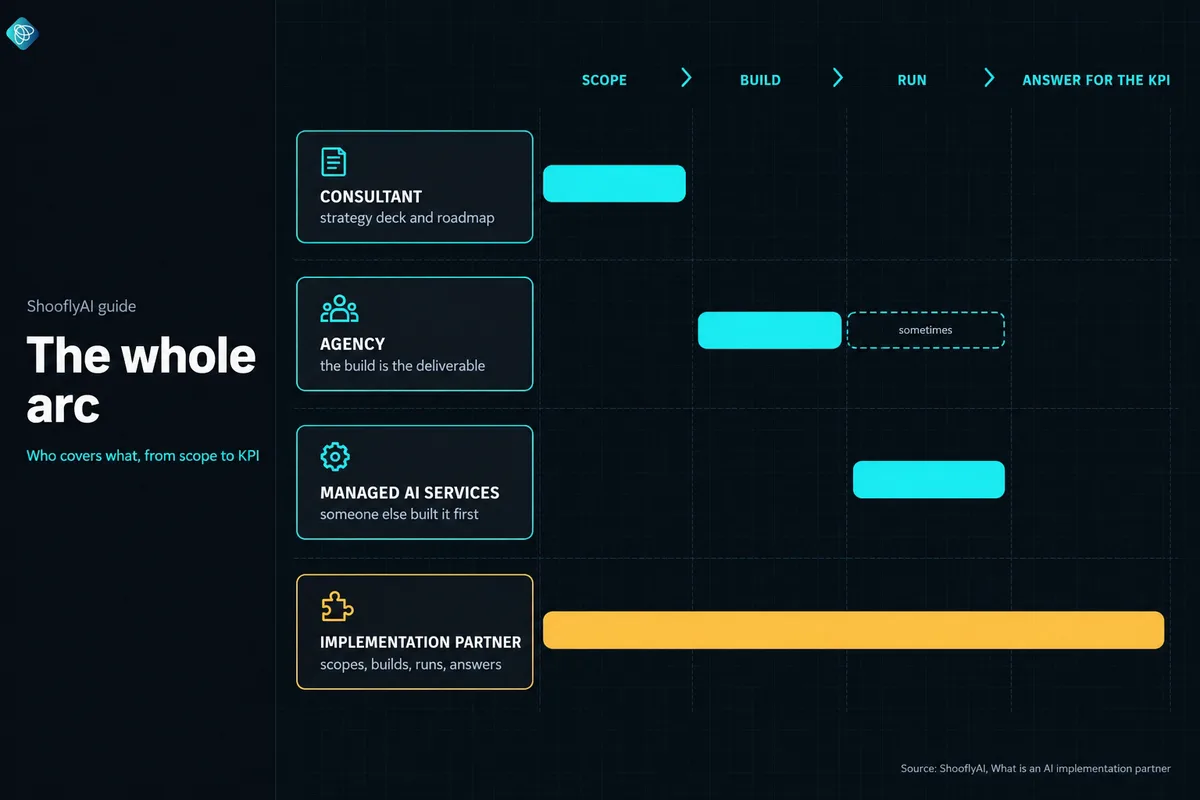
An AI consultant assesses, strategizes and advises. You get a strategy deck and a roadmap. You do not get working software.
An AI automation agency designs, builds, deploys and sometimes manages. Most of this market leans toward small businesses. The build is the deliverable, and the handoff often ends the relationship.
Managed AI services operate, govern and improve AI that is already in production. Twelverays defines the category around running production AI (source). Someone else built the system first.
An implementation partner covers the whole arc. It scopes the function, builds the system, runs it, and answers for the KPI.
The full side-by-side is in AI implementation partner vs. consultant vs. agency.
What does the work include?
The work has four parts. They show up in most engagements regardless of who runs them.
A scoped function
The partner picks one business function with a measurable outcome. Examples include month-end close, lead routing and client onboarding. The scope is a function, and the success metric belongs to that function.
A system built around your data and tools
A typical stack has four pieces. A knowledge base sits over your documents and records. Connectors reach into the systems you already run. AI agents do the repeatable work. A dashboard shows you all of it.
Operations after launch
Someone watches the system every week. They handle exceptions, adjust prompts when the process changes, and add the next agent when the first one is stable.
Ownership transferred to you
The code, the data, the prompts and the infrastructure sit in your accounts. If the partner leaves, the system keeps running.
That last part is where partners differ most. Some keep the system on their platform and rent you access. Ask before you sign. How to choose an AI implementation partner has a checklist for that conversation.
What does “runs a business function” mean in practice?
It means the AI layer does the defined work of the function every day. People handle exceptions and decisions.
Strickland CPA is a concrete example. The firm has five AI agents in production. It ran tax season on a Shoofly dashboard. Document routing is automated. DocuSign is integrated into the flow. Weekly EBITDA reporting runs on the system. The firm’s own summary:
Strickland CPA
"Five agents we own now do the admin work that used to eat our weeks. We got our time back, and the system is ours."
Note what the quote covers. It names admin work, time returned, and ownership. Those are the three things a partner should be able to show you.
When do you need one?
You need an implementation partner when a few conditions line up.
- You have a function where manual work caps growth. The team is the bottleneck, and hiring is slow or expensive.
- You want a working system, and a strategy deck will not move the number.
- You lack an internal team that can build and run AI in production.
- You want to own the result. Renting a per-seat tool for core work does not fit your plan.
- You can name a KPI the system should move within a quarter.
Companies in the $10M to $75M range hit this profile often. They have real process and real data. They rarely have a machine learning team on payroll. The gap between those two facts is what a partner fills.
When do you not need one?
Be honest here. A partner is the wrong call in several situations.
A single SaaS tool already does the job well
If a single SaaS tool already does the job well, buy the tool.
You have an internal engineering team with capacity
Give them the project.
The process itself is broken
Fix the process first. AI on top of a bad process makes a faster bad process.
You cannot name the function or the metric
Start with a diagnostic and decide after.
Alternatives to hiring an AI implementation partner walks through each of those paths and when it wins.
What does an engagement look like?
Engagements in this category usually start with a paid diagnostic, then move to a build and an operating retainer. The diagnostic picks the function and sets the KPI. The build ships the first working system. The retainer keeps it running and adds scope.
ShooflyAI’s version starts with an Operating Blueprint. It costs $6,000 through December 31, 2026, and $10,000 after that. The fee is credited to the retainer if you move forward. The retainer starts at $7,500 a month and is priced per function. Other partners price differently. Ask for the price shape before you compare anyone.
Speed varies by function and by how fast you can grant access. When the scope is one function and the tools have APIs, a first system can be live in days once credentials are issued. When the scope is a department or the systems have no APIs, it is weeks.
What to do next
Write down one function and one number you want moved. Then decide whether you need advice, a build, an operator, or all three. If you want a costed plan for that function before committing to anyone, book a Blueprint. You keep the plan whichever way you go.
Frequently asked questions
What is an AI implementation partner?
An AI implementation partner is a firm responsible for getting AI to work inside your business and staying accountable after launch. It scopes one business function, builds the AI layer around your data and tools, operates it after go-live, and answers for the function's KPI. In the ownership model, the client keeps the code, data and infrastructure.
How is an AI implementation partner different from an AI consultant?
An AI consultant assesses, strategizes and advises. The deliverable is a strategy deck or roadmap, with no working software. An implementation partner delivers the working system and then runs it. Many partners still do the assessment step, but the engagement does not end there.
How is an AI implementation partner different from an AI automation agency?
An AI automation agency designs, builds and deploys, and the market leans toward small businesses. The build is the deliverable, and the handoff often ends the relationship. An implementation partner stays accountable after launch, runs the system against a KPI, and in the ownership model hands you the code and data.
What does 'runs a business function' mean?
It means the AI layer does the defined, repeatable work of a function every day, and people handle exceptions and decisions. Strickland CPA is one example: five AI agents in production, tax season run on a Shoofly dashboard, automated document routing, a DocuSign integration, and weekly EBITDA reporting.
When does a company need an AI implementation partner?
When a function is capped by manual work, a strategy deck will not move the number, there is no internal team that can build and run AI in production, the company wants to own the result, and leadership can name a KPI the system should move within a quarter. Companies in the $10M to $75M range hit this profile often.
When is an AI implementation partner the wrong choice?
When a single SaaS tool already does the job well, when an internal engineering team has capacity, when the underlying process is broken and needs fixing first, or when the company cannot yet name the function or the metric. In those cases buy the tool, use the team, fix the process, or start with a diagnostic.
What does an engagement with an AI implementation partner cost?
Price shapes vary by firm. ShooflyAI's engagement starts with an Operating Blueprint at $6,000 through December 31, 2026, and $10,000 after that, credited to the retainer if you move forward. The retainer starts at $7,500 a month and is priced per function. Other partners price differently, so ask for the price shape before comparing.