
Alternatives to Hiring an AI Implementation Partner (And When Each Is Right)
Most posts about AI implementation partners are written by AI implementation partners. This one is too, so read it with that in mind. The point is to lay out the real alternatives. Each section says when that option beats hiring a partner. If one of them fits your situation, take it. ShooflyAI would rather lose a deal than run a bad engagement.
The five alternatives are an internal team, a SaaS or agent platform, a large consultancy, a freelancer or fractional builder, and waiting. Each has a set of conditions under which it is the right call.
1Hire an internal AI team
This is the option most CEOs consider first. Hire an engineer or two, give them a mandate, and own the whole thing from day one.
AI is core to your product, or it will be. There is enough work to keep the team busy for years. You can recruit and retain that talent in your market and at your pay scale. You already have engineering leadership who can manage the roadmap.
You need one business function fixed. An internal team for one function is slow to hire and expensive to keep. It is hard to retain once the interesting work is done. Recruiting alone can take a quarter. The first working system often lands six months or more after the decision.
The middle path
Some companies hire a partner to build the first function and then hire internally to run it. The system is already in your accounts, so the handoff is a knowledge transfer. That works well when the partner builds in your environment and gives you the code.
2Buy a SaaS or agent platform
The market is full of tools that promise AI agents in a box. Some are excellent. Most price per seat and keep the logic on their side.
The work is commodity and identical to what every company needs. A standard tool already does the job well. Your process for that work is not a competitive edge. Examples include email, calendars, basic CRM, and generic document search.
The work is core, steady, and specific to how you make money. A rented tool cannot follow your exact process. It charges you for headcount as you grow. It leaves you with no asset if you stop paying. We covered this trade-off at length in build vs. buy vs. own.
The test
Ask what happens on the day you cancel. If the answer is that the work stops, you were renting a function. That is fine for the edges and risky for the core.
3Engage a large consultancy
The big firms sell AI programs to enterprises. They bring scale, process, and a brand that reassures a board.
The program spans many business units. It needs change management at the executive level. It has to survive heavy regulatory review. You have the budget for a large team and the patience for a long timeline.
You need one function to work in a quarter. Large consultancies are built for programs. A single function is too small to get their best people. The strategy team and the build team are usually different, and the handoff between them is where projects lose months.
The ownership question
Ask who owns the code and where it runs. Large firms have accelerators and internal platforms, and the answer is not always in your favor.
4Hire a freelancer or fractional builder
A strong independent builder can ship fast and cheap. The market for this talent has grown, and some of it is very good.
You need a prototype to test an idea. You need one contained integration with a clear spec. You have someone internally who can own the system once it ships. Budget is tight and the downside of failure is small.
The system has to run every day for years. One person has no bench. Vacations, illness, and better offers all stop your function. Accountability ends when the contract ends. Security review is thin, and a single-person shop rarely has a documented posture.
The pairing
A freelancer plus managed AI services can work. The freelancer builds and a managed services provider runs it. Twelverays describes managed AI services as the work of operating, governing and improving production AI (source). That combination gives you a builder and an operator, with two contracts to manage.
5Do nothing yet
Waiting is a legitimate choice, and some companies should take it.
The process you want to automate is broken. AI on a broken process gives you a faster broken process. Fix the process first. You cannot name the function or the KPI. Wait until you can, because a partner will ask on the first call. Cash is tight and no function is capped by manual work.
A function is capped by manual work today, and hiring is slow or expensive. Your competitors are moving on the same function. The team is burning out on admin. In those cases the cost of waiting compounds every month.
A cheap way to stop waiting
A paid diagnostic names the function and the KPI without committing you to a build. It is the smallest step that produces a decision.
Where an AI implementation partner fits
A partner is the right call when four things are true at once.
You need a function built, and a strategy deck will not move the number.
You need it run after launch, and you have no internal team to do that.
You want to own the result, so a rented platform does not fit.
You can name the function and a KPI.
Master of Code defines the category as the firm responsible for getting AI to work inside your business and staying accountable after launch (source). The full definition, with when you need one, is in What is an AI implementation partner?.
ShooflyAI is one partner in that category. It works with $10M to $75M companies, builds the AI layer that runs one business function, and hands the client the code, data and infrastructure. Strickland CPA is an example: five AI agents in production, tax season run on a Shoofly dashboard, automated document routing, a DocuSign integration, and weekly EBITDA reporting. Other partners exist with different models, and the 10-point checklist for choosing one applies to all of them.
A simple way to choose
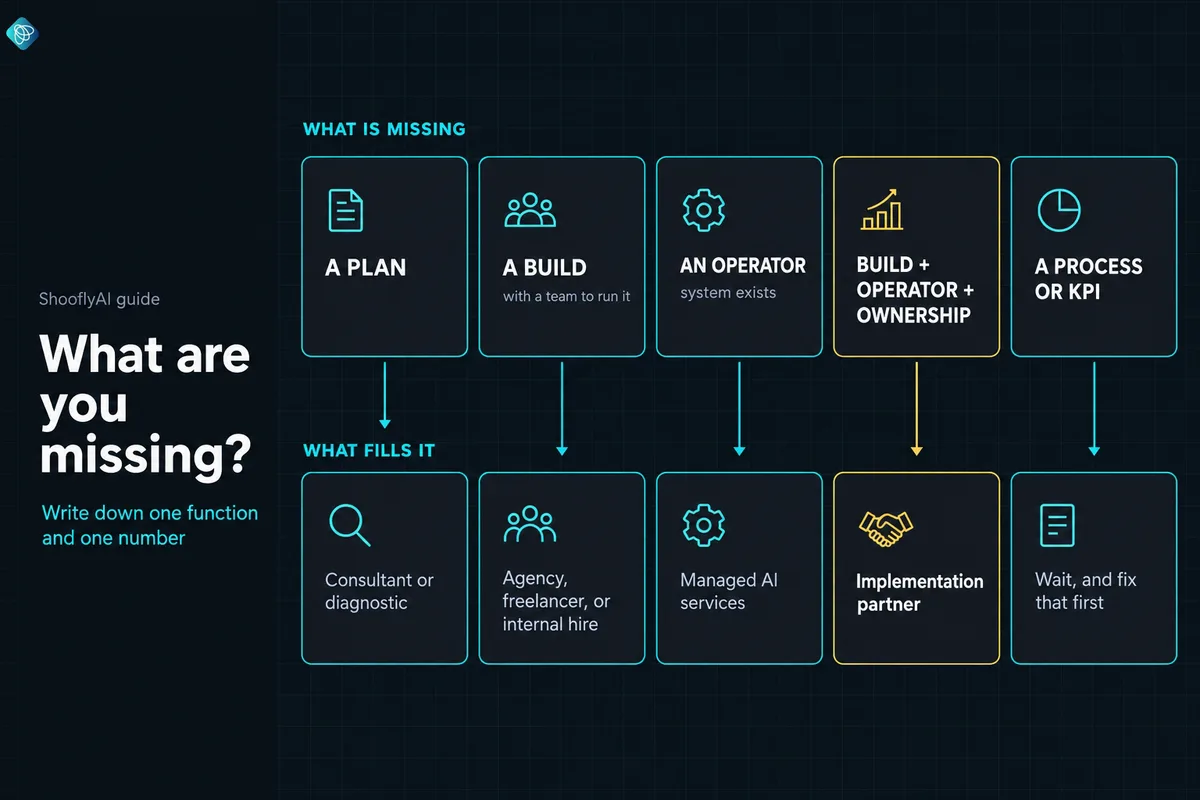
Write down one function and one number. Then ask what is missing.
Consultant or diagnostic.
Agency, freelancer, or internal hire.
Managed AI services.
Implementation partner.
Wait, and fix that first.
If you want a costed plan for one function before you pick any of these, book a Blueprint. The plan is yours to keep, and it will tell you which of the five paths fits.
Frequently asked questions
What are the alternatives to hiring an AI implementation partner?
Hire an internal AI team, buy a SaaS or agent platform, engage a large consultancy, hire a freelancer or fractional builder, or wait. Each fits a different situation. The right choice depends on whether you need a plan, a build, an operator, or all three, and on whether you want to own the result.
When should a company hire an internal AI team over a partner?
When AI is core to the product, when there is enough work to keep engineers busy for years, and when the company can recruit and retain that talent. For a single business function, an internal hire is usually slower and more expensive than a partner. For a product line, it is often the right call.
When is buying a SaaS or agent platform the better option?
When the work is commodity and identical to what every company needs, when a standard tool already does it well, and when the process is not a competitive edge. Buy for the edges of the business. For core, steady, high-value work, a rented tool charges per seat forever and leaves you with no asset.
When does a large consultancy make sense?
When the program spans many business units, needs board-level change management, or has to satisfy heavy regulatory review. Large consultancies bring scale and process. They are expensive for a single function, and the working software often comes from a different team than the one that wrote the strategy.
Can a freelancer replace an AI implementation partner?
For a prototype or a contained integration, yes. A strong freelancer is fast and inexpensive. The risk is continuity: one person, no bench, and no accountability once the contract ends. If the system must run every day for years, plan for who operates it after the freelancer moves on.
Is doing nothing ever the right choice?
Yes. If the process is broken, fix the process first. If you cannot name the function or the KPI, wait until you can. If cash is tight and no function is capped by manual work, wait. The cost of waiting is real, but the cost of building the wrong thing is higher.
How do I decide between these options?
Name one function and one KPI. Then ask what is missing: a plan, a build, an operator, or ownership. A consultant gives a plan. A platform gives a rented build. A freelancer gives a one-time build. A partner gives a build plus an operator plus ownership. Choose the one that fills your specific gap.