
When a $10M to $75M Company Needs an AI Implementation Partner: Use Cases by Function

The question is rarely whether a $10M to $75M company should use AI. The question is where. The answer is almost always one business function, picked because manual work caps it and a KPI already measures it. This post walks through the four functions where an AI implementation partner most often earns its place. For each one, it says what “the AI runs the function” means in concrete terms.
If you want the category definition first, read What is an AI implementation partner?. In short, it is the firm responsible for getting AI to work inside your business and staying accountable after launch, per Master of Code (source).
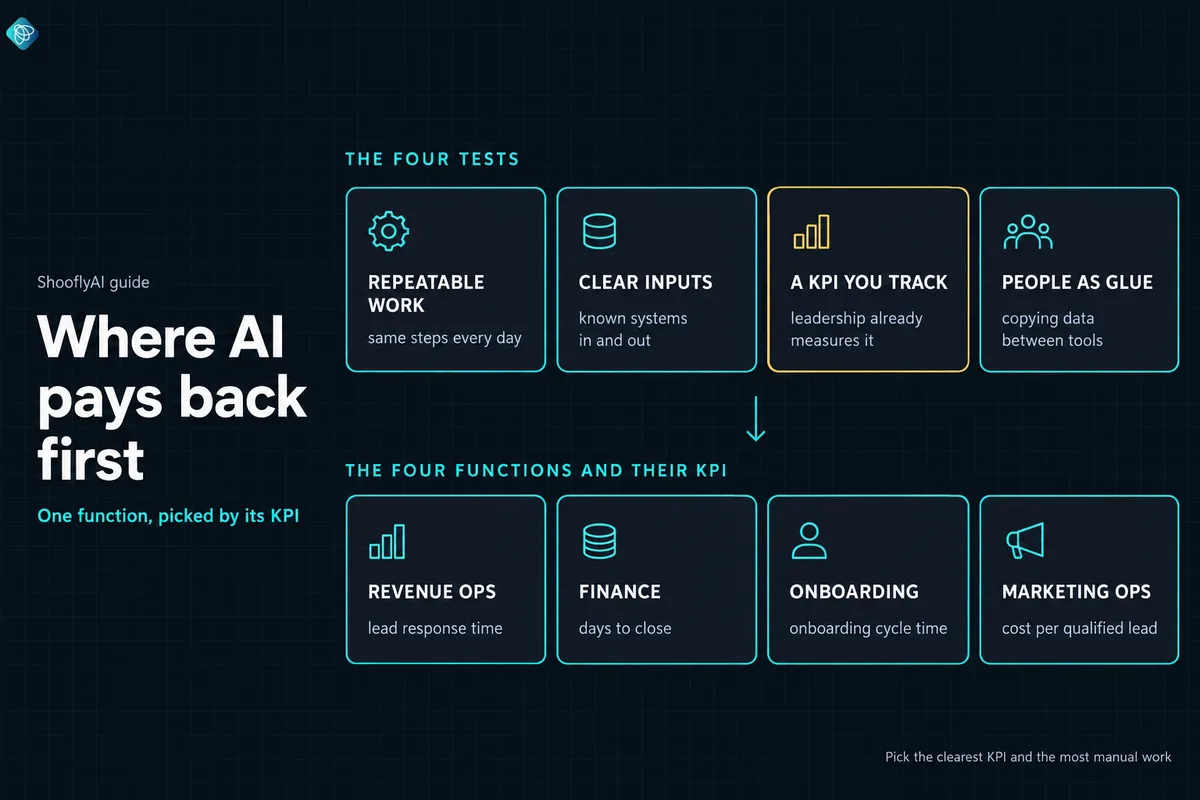
What makes a function a good candidate?
Four traits show up in every function that works.
Repeatable daily work
The same steps run every day or every week, with variations a person can describe.
Clear inputs and outputs
Work arrives from known systems and lands in known systems.
A KPI leadership already tracks
Days to close, lead response time, onboarding cycle time, cost per qualified lead.
People acting as glue
Someone is copying data between tools, chasing missing items, or sending the same update by hand.
When a function has all four, the AI layer can do the repeatable part. People keep the judgment part. When it lacks one, fix that first.
Revenue ops
Revenue ops is the function most likely to have a team acting as glue. Leads arrive in one tool, calls are logged in another, and the CRM is out of date by Friday.
Revenue ops at a glance
The AI layer: qualifies and routes inbound leads, turns call notes into CRM updates, drafts follow-ups, flags stalled deals and builds the weekly pipeline report. The KPI: lead response time, CRM completeness or forecast accuracy.
What “runs the function” means. Inbound leads are qualified against your criteria and routed to the right rep within minutes. Call notes become CRM updates without a rep typing. Follow-up drafts wait in the rep’s inbox after each call. Stalled deals are flagged with the reason. The weekly pipeline report builds itself from data that is actually current.
The KPI. Lead response time, CRM completeness, and forecast accuracy are the usual choices. Pick one to start.
What the partner builds. Connectors into the CRM, calendar, call recorder and inbox. A knowledge base with your qualification rules and playbooks. Agents for routing, note capture and follow-up drafting. A dashboard where the sales leader sees it all.
When a partner is the wrong call. If your CRM vendor already ships an AI feature that does the job well, buy the feature. If the sales process changes every month, stabilize it first.
Finance and month-end
Finance is where the ROI is easiest to defend, because the function already runs on a calendar and produces numbers.
What “runs the function” means. Documents arriving by email or portal are classified and routed to the right folder and the right person. Missing items are chased on a schedule. Signature workflows fire from the system that needs the signature. Recurring reports are produced on the day they are due, from the source data. The close checklist advances itself, and a controller reviews exceptions.
A named example. Strickland CPA runs five AI agents in production on a system the firm owns. It ran tax season on a Shoofly dashboard. Document routing is automated. DocuSign is integrated. Weekly EBITDA reporting runs on the system. The firm’s summary: “Five agents we own now do the admin work that used to eat our weeks. We got our time back, and the system is ours.”
Five in production
On a system the firm owns.
Run on a Shoofly dashboard
The firm ran tax season from one dashboard.
Routing and signatures
Document routing is automated, and DocuSign is integrated.
Weekly EBITDA
Weekly EBITDA reporting runs on the system.
The KPI. Days to close, hours of admin per period, and report delivery on time are the common ones.
What the partner builds. Connectors into the accounting system, the document store, e-signature and email. A knowledge base with the chart of accounts, the close checklist and the SOPs. Agents for routing, chasing, signature and reporting. A dashboard for the controller or CFO.
Delivery and client onboarding
Onboarding is where growth breaks first. Every new client needs the same twenty steps, and a person is running them from a spreadsheet.
Onboarding at a glance
The AI layer: starts the onboarding plan from a signed agreement, creates accounts, sends and tracks intake forms, chases missing information and keeps a current status page. The KPI: onboarding cycle time and time to first value.
What “runs the function” means. A signed agreement triggers the onboarding plan. Accounts are created, welcome messages go out, and intake forms are sent and tracked. Missing information is chased until it arrives. Internal handoffs between sales, delivery and finance happen on schedule. The client sees a status page that is current. The delivery lead sees every account and every open item in one place.
The KPI. Onboarding cycle time and time to first value for the client. Both are easy to measure before and after.
What the partner builds. Connectors into the CRM, the project tool, the messaging channels and the billing system. A knowledge base with the onboarding plan and the client-facing templates. Agents for kickoff, intake, chasing and status. A cockpit for the delivery lead.
A note on speed. Go-live pace depends on the tools and on how fast credentials arrive. When the tools have APIs and the scope is one function, a first system can be live in days. When the scope is a department, or a core system has no API, plan in weeks and ask the partner for the date in writing.
Marketing ops
Marketing ops is the function with the most rented tools and the least ownership. The team pays per seat for a dozen platforms and still assembles reports by hand.
Marketing ops at a glance
The AI layer: turns campaign briefs into first drafts in the brand voice, tracks published content across channels, keeps attribution intact from form to CRM and builds the weekly performance report. The KPI: cost per qualified lead, content throughput or reporting hours per week.
What “runs the function” means. Campaign briefs become first drafts in the brand voice, ready for a human edit. Published content is tracked across channels without a spreadsheet. Lead forms flow to the CRM with attribution intact. The weekly performance report builds itself from the ad, email and web platforms. The marketing lead reviews and decides, and the assembly is done.
The KPI. Cost per qualified lead, content throughput, and reporting hours per week.
What the partner builds. Connectors into the ad platforms, email tool, CMS and analytics. A knowledge base with brand guidelines, past campaigns and audience definitions. Agents for drafting, tracking and reporting. A dashboard for the marketing lead.
When a partner is the wrong call. If the team is small and a single marketing platform does most of this well, buy the platform. Ownership matters less at the edges. Build vs. buy vs. own covers where that line falls.
How do you pick the first function?
Pick the function with the clearest KPI and the most manual work. Ignore the function that is most interesting. The first system has to prove the model, so choose the one where proof is easiest to measure.
Then get it stable before adding the next one. The knowledge base and the connectors carry over. The second function is faster than the first because the foundation exists.
Who should do the work?
A partner is one option among several. An internal team can do it if you have one. A platform can do it if the work is commodity. A freelancer can build it if someone in-house can run it.
A partner
Responsible for getting AI to work inside your business, and accountable after launch.
An internal team
Works if you have one.
A platform
Works if the work is commodity.
A freelancer
Works if someone in-house can run what gets built.
Alternatives to hiring an AI implementation partner covers when each one wins.
ShooflyAI is one partner in this category. It works with $10M to $75M companies, builds the AI layer that runs one function, and hands the client the code, data and infrastructure. Whichever firm you consider, run the 10-point checklist for choosing a partner before you sign.
Start with a costed plan
Name the function and the number. If you want a costed plan for that function, with a ranked list of where the manual work sits, book a Blueprint. You keep the plan whether you build with us, with someone else, or in-house.
Frequently asked questions
Which business functions are the best fit for an AI implementation partner?
Functions with repeatable daily work, clear inputs and outputs, and a KPI leadership already tracks. The common ones are revenue ops, finance and month-end close, delivery and client onboarding, and marketing ops. Each has a measurable outcome and a team currently acting as the glue between systems.
What does it mean for AI to 'run' a business function?
The AI layer does the defined, repeatable work of the function every day: reading inputs from your systems, doing the work, writing results back, and logging every action. People handle exceptions, approvals and decisions. The function's KPI is the measure of whether the system is working.
What does an AI implementation partner do in finance and month-end?
It builds agents that route documents, reconcile records, chase missing items, and produce recurring reports. Strickland CPA is one example: five AI agents in production, tax season run on a Shoofly dashboard, automated document routing, a DocuSign integration, and weekly EBITDA reporting.
What does an AI implementation partner do in revenue ops?
It builds agents that qualify and route inbound leads, keep the CRM current, draft follow-ups from call notes, and flag stalled deals. Running the function means the CRM reflects reality without reps typing, and the handoffs between marketing, sales and account management happen without a person pushing them.
How fast can a function go live?
It depends on the function and on how fast you can grant access. When the scope is one function and the tools have APIs, a first system can be live in days once credentials are issued. A department-wide build, or systems without APIs, takes weeks.
Should a company start with one function or several?
One. Pick the function with the clearest KPI and the most manual work. Get it stable, measure the result, and then add the next function on the same knowledge base and connectors. Starting with several at once spreads attention thin and makes the result hard to measure.
What signals mean it is time to hire a partner?
A function where manual work caps growth. A team acting as glue between systems. Hiring that is slow or expensive for that role. A KPI you can name. No internal team that can build and run AI in production. When most of those are true for one function, it is time.